
Maths at Oak Hill CE Primary School
Maths is a vital life skill that helps children make sense of the world around them. From understanding patterns and solving problems to managing money and interpreting information, maths equips children with the confidence and logical thinking they need for everyday life. A strong mathematical education builds resilience, curiosity and the ability to reason- skills they empower children to make informed decisions and approach challenges with independence. At Oak Hill, we believe developing secure mathematical understanding opens doors to future learning, supports success across the curriculum and helps every child learn, grow and flourish.
Maths curriculum intent
Our intent is to ensure that every child:
- Develops strong fluency in number and calculation, enabling them to recall and apply key facts efficiently and with confidence.
- Uses accurate and precise mathematical vocabulary, empowering them to articulate their thinking clearly and engage meaningfully in mathematical dialogue.
- Builds secure reasoning skills, enabling them to make connections, justify their ideas and explain their methods with clarity.
- Approaches problem solving with perseverance, applying their knowledge creatively and flexibly to tackle challenges.
- Sees mistakes as valuable learning opportunities, understanding that productive struggle is a natural and important part of becoming a successful mathematician.
Maths curriculum implementation
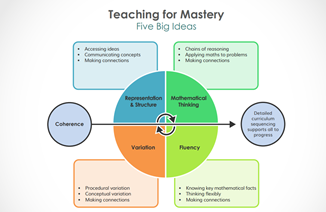
At Oak Hill, we deliver our mixed age maths lessons using White rose Education and Mastering Number. The use of these comprehensive schemes ensures full coverage of the national curriculum and allows children to build on previous learning. In addition to this teacher utilise high quality resources from Testbase and Twinkl Mastery to provide further challenge, deepen understanding and extend reasoning opportunities.
Time allocation
- daily maths lessons
- total weekly teaching time 4.5-5 hours
- additional short fluency sessions as required
- Flexible interventions based on assessment outcomes
This structure aligns with national expectations, supports a mastery approach and provides sufficient depth for reasoning and problem- solving.
Hight quality mathematical vocabulary and clear modelling are central to teaching at oak hill. Each unit includes specific terminology that is explicitly taught and used consistently. This ensures clarity, reduces misconceptions and enables children to articulate their reasoning with precision.
Maths curriculum impact
Through high-quality teaching and carefully chosen resources, children become fluent and confident mathematicians at each stage of their time at Oakhill. Our curriculum is thoughtfully sequenced to build secure foundations, deepen understanding and promote mastery, ensuring that every child can succeed and feel proud of their progress. By the time they leave us, children have the skills, mathematical language and confidence to apply their knowledge in the wider world.
We are committed to helping our children flourish mathematically — not only in accuracy and fluency, but in reasoning, problem-solving and resilience. They are encouraged to think critically, make meaningful connections, spot patterns and explain their thinking with clarity. Through real-life contexts and purposeful problem-solving opportunities, children understand how mathematics supports everyday decision-making, from managing money and measuring accurately to interpreting data and solving practical challenges. Most importantly, we foster a love of maths, nurturing curiosity and enjoyment so that children see mathematics not simply as a subject, but as an essential life skill that empowers them now and in the future.
This is the impact of our curriculum and the rich mathematical experiences children at Oakhill engage in every day — confident learners who enjoy mathematics, understand its relevance, and are well prepared to use their knowledge successfully beyond the classroom.
Supporting curious minds at home
There are a number of ways children can enjoy maths at home, for some children lessons are hard and real world experiences are a really useful way to help bring maths to life!
EYFS
- pattern spotting
- counting and organising objects
- finding shapes in nature
- Simple baking, measuring in spoons or cups.
KS1
- counting objects, start counting in 2s, 5s and 10s.
- measuring water
- board games such as snakes and ladders
- Learning to tell the time using an analogue clock
- play with money
KS2
- shopping, ask children to weight items, calculate change
- Baking and cooking to exact recipe using measurements and timings
- Telling the time, go on a day trip using buses or trains that require reading timetables.
Maths games and resources

Our Maths Curriculum
Please see the document below for more detials about our maths curriculum including out full intent document and progression documents.

|
pq-primary-academy-whole-school-maths-vocabulary | [pdf 222KB] |

|
|
|
Maths at Oak Hill C of E Primary School | [pdf 149KB] |
|
|
|
Maths SMSC and BV Document | [pdf 162KB] |
|